• 2013 Bugatti Veyron Grand Sport Vitesse

    From Alsace, France. Maximum output 1200 hp @ 6400 rpm and torque 1,500 Nm @ 3000-5000 rpm. Acceleration (0-100 kmh) in 2.6 sec and top speed is 408.84 kmh

  • 2012 Mitsubishi Lancer Evolution X

    From Okayama, Japan. Maximum output 300 hp @ 6500 rpm and torque 422 Nm @ 3500 rpm. Acceleration (0-100 kmh) in 4.5 sec

  • 2013 Audi R8 V10 Plus

    From Neckarsulm, Gerrmany. Maximum output 525 hp @ 8000 rpm and torque 530 Nm @ 6500 rpm. Acceleration (0-100 kmh) in 3.7 sec and top speed is 333 kmh

  • 2012 Aston Martin One-77

    From Warwickshire, United Kingdom. Maximum output 760 hp and torque 750 Nm. Acceleration (-0-100 kmh) in 3.7 sec and top speed is 354 kmh

  • 2013 Volkswagen Passat 1.8 TSI

    From Emden, Germany. Maximum output 160 hp @ 5000-6200 rpm and torque 250 Nm @ 1500-4200 rpm. Acceleration (0-100 kmh) in 8.6 sec and top speed is 220 kmh

  • 2011 Koenigsegg Agera R

    From Ängelholm, Sweden. Maximum output 1139 hp @ 7100 rpm and torque 1200 Nm @ 4100 rpm. Acceleration (0-100 kmh) in 2.8 sec and top speed is 438 kmh

  • 2014 BMW i8

    From Leipzig, Germany. Maximum output 362 hp and torque 570 Nm (combined petrol and hybrid). Mid-range acceleration (80-120 kmh) in 2.6 sec and electronically controlled top speed is 250 kmh

  • 2014 Lamborghini Aventador LP 700-4 Roadster

    From Sant'Agata Bolognese, Italy. Maximum output 700 hp @ 8250 rpm and torque 690Nm @ 5500 rpm. Acceleration (0-100 kmh) in 2.9 sec and top speed is 349 kmh

  • 2015 Ford Mustang GT

    From Flat Rock, Michigan. Maximum output 435 hp and torque 542 Nm

  • 2012 Ferrari F12berlinetta

    From Maranello, Italy. Maximum output 740 hp @ 8250 rpm and torque 690 Nm @ 6000 rpm. Acceleration (0-100kmh) in 3.1 sec and top speed is 362 kmh

Translate

Showing posts with label Perodua. Show all posts

Perodua Axia

2 comments
Perodua Axia
Overview
Manufacturer
Perodua
Production
2014 -
Model years
2014 -
Assembly
Rawang, Malaysia
Body and chassis
Class
Kei car / A-segment
Body style
Five-door hatchback
Layout
Front-engine, front-wheel drive
Related
Daihatsu Ayla
Toyota Agya
Daihatsu Mira e:S
Powertrain
Engine
1.0L 1KR-DE2 l3
Transmission
5-speed manual
4-speed automatic
Dimensions
Wheelbase
2,450 mm (96.5 in)
Length
3,640 mm (143.3 in)
Width
1,620 mm (63.8 in)
Height
1,510 mm (59.4 in)
Chronology
Predecessor
Perodua Viva


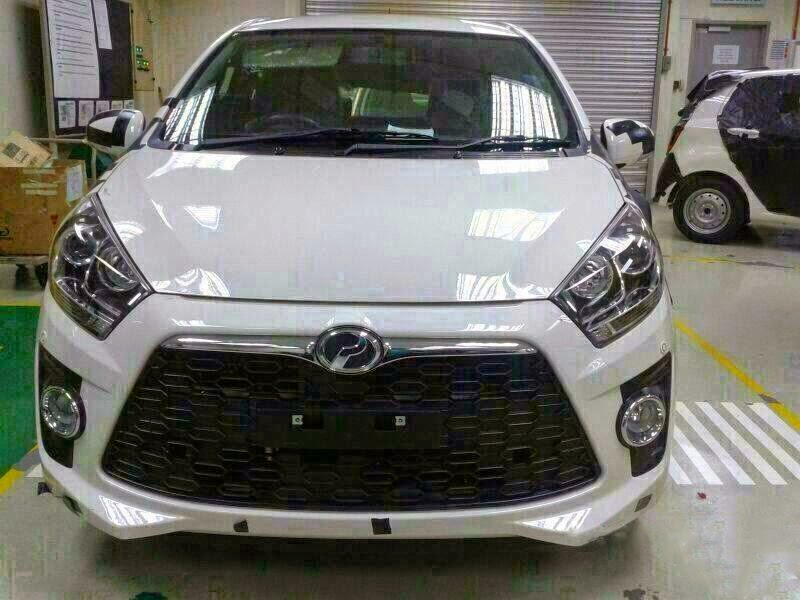
The Perodua Axia is a five-door hatchback in development by Malaysian automobile manufacturer, Perodua. It will launch in the second half of 2014 as the successor to the Perodua Viva. The Perodua Axia is a badge engineered Daihatsu Ayla, which is in turn a rebadged seventh-generation Daihatsu Mira e:S. The Axia will be the first model to début from Perodua's all-new second factory in Rawang, Selangor.
The name ‘Axia’, which is pronounced ‘a-zee-a’ or ‘A-xia’, is derived from the word Asia. The letter ‘x’ in ‘Axia’ also represents the number ten, as the Axia is Perodua's tenth model.

History

Pre-launch

The Perodua Axia has been in development as the successor to the Perodua Viva. Perodua chose to license the Daihatsu Ayla / Toyota Agya platform for their Viva Replacement Model (VRM).[2] The Ayla and Agya duo have been on sale in neighbouring Indonesia and Philippines since 2013, but not in Malaysia. The Ayla and Agya duo are in turn based on the seventh-generation Daihatsu Mira e:S, which launched in Japan in 2011. Although the Viva replacement model will be based on the Ayla / Agya platform, Perodua has iterated that the upper body and external elements will be indigenously designed, and the car will not be just a rebadged model.
On 26 August 2013, the Prime Minister of Malaysia, Najib Razak announced that the replacement model to the Viva will launch in 2014 as the cheapest new car on the market. The new model will be built at Perodua's all-new RM1.3 billion, 65,000 sq ft second manufacturing plant, located adjacent to the company's original factory in Rawang, Selangor. Perodua's new factory will mirror Daihatsu Kyushu's factory in terms of work ethics, technology and efficiency. Perodua has since announced the construction of a new engine manufacturing factory in Sendayan, Negeri Sembilan at cost of RM600 million.
Perodua showcased the Global Model A Segment Space (GMA) concept at the 2013 Kuala Lumpur International Motor Show in November The GMA previewed the interior design of the Viva Replacement Model (VRM). Perodua also showcased a new engine, the 1.0 litre Daihatsu D26F-1KR-FE as a possible candidate for the VRM.
On 11 June 2014, the first spyshots of an undisguised Perodua Axia were leaked online. Further photos of various pre-launch Perodua Axia units have since been leaked online, but on 6 August 2014, additional photos revealed the final product name was indeed ‘Perodua Axia’, after months of media speculation.
On 11 August 2014, Perodua teased a photo of the Axia on their official Facebook page. Three days later, Perodua announced that bookings for the Axia have been opened, with prices starting from RM24,900 along with a five-year warranty, a first for a Perodua model. The following day, the first official photo from Perodua confirmed the product name ‘Axia’ along with the tagline ‘Your Smart Move’. Later that same day, even more extensive official details on the Axia were unveiled.
The tentative pricing and equipment list for the Perodua Axia was leaked online on 14 August 2014.
The Perodua Axia, which is an A-segment small car will not compete with the similar but more upmarket B-segment Proton GSC, which is also scheduled for launch in the second half of 2014.
2014 Proton Axia interior

Safety

Safety features
Trim Variant
Standard E
Standard G
SE
Advance
Market
Malaysia
ABS with EBD and BA
✘
✔
ESC and TCS
✘
Airbags
TBA
  •  / Malaysia - ASEAN NCAP - 4/5 stars
The Perodua Axia has been crash tested by the New Car Assessment Program for Southeast Asia (ASEAN NCAP), and has claimed a 4-Star rating, thus being the second Perodua model to score a 4-Star rating after the Alza. The Axia is also safer than the 3-Star rated Myvi, despite being a smaller car.
The Perodua Axia SE and Advance variants are equipped with an Anti-lock braking system (ABS) with Electronic brakeforce distribution (EBD) and Brake assist (BA). The cheaper, no-frills Axia Standard E and G variants are not equipped with the aforementioned features. Perodua has yet to publicise information on airbag specifications across the Axia variants.
The ASEAN NCAP has yet to announce the official scores for the Perodua Axia, but it is assumed that the 4-Star rating is only applicable for the Axia SE and Advance variants.

Powertrains

Manufacturer's claim
Engine
1KR-DE2
Format
I3 DOHC 12V
Total displacement (cc)
998
Bore x Stroke (mm x mm)
71 x 84
Maximum Output [hp(kW)/rpm]
66 (49) / 6,000
Maximum Torque (Nm/rpm)
90 / 3,600
Maximum Speed (km/h)
TBA
Acceleration 0–100 km/h (sec)
TBA
Fuel tank capacity (litres)
TBA
The Perodua Axia will only be offered with one petrol engine, the 998cc 12-valve DOHC 1KR-DE2 l3, sourced from Toyota and Daihatsu. The new 1.0 litre engine offers 66 hp (49 kW) at 6,000 rpm and 90 Nm (66 lb ft) of torque at 3,600 rpm. It is Perodua's first engine to be made with aluminiumparts, which are lighter than their cast iron equivalents. As a result, the new 1KR-DE2 engine weighs 69 kg, or 10 kg less than the old 989cc EJ-VE engine in the Perodua Viva. Unlike the 1KR-FE engine, The 1KR-DE2 in the Axia is not equipped with Toyota's Variable Valve Timing with intelligence (VVT-i) technology. The new engine is also Euro IV compliant.
The sole 1.0L engine in the Axia is paired to a choice of two transmissions, a five-speed manual and a four-speed automatic respectively. Perodua claims that the Axia is capable of achieving up to 21.6 km/L with the manual, and 20.1 km/L with the automatic while in ‘ECO Mode’. The Axia will become the first car to quality under Malaysia's 2014 National Automotive Policy (NAP) Energy Efficient Vehicle (EEV) fuel-efficiency standards upon its late 2014 launch.


Back to Perodua
Last updated on 16 August 2014 at 19:11.

Read More »

Perodua Kenari

1 comments
Manufacturer
Perodua
Production
2000 – 2009
Class
Supermini
Body style
5-door mini MPV
Layout
FF layout
Engine
989 cc, water-cooled, in-line 3-cylinder, 4-cycle, DOHC
Wheelbase
2,360 mm (92.9 in)
Length
Overall - 3,460 mm (136.2 in)
Interior - 1,760 mm (69.3 in)
Width
Overall - 1,500 mm (59.1 in)
Interior - 1,220 mm (48.0 in)
Height
Overall - 1,660 mm (65.4 in)
Interior - 1,320 mm (52.0 in)
Curb weight
865 kg (1,907 lb) - 880 kg (1,940 lb)
Related
Daihatsu Move
Proton Juara
Perodua MyVi
The Perodua Kenari is a small four-seat compact car or supermini car produced by Malaysian automotive company Perodua. The Kenari is based on the first and second generation Daihatsu Move kei car (minicar) but is powered by a 1.0 litre DOHC engine. In 2004, the Perodua Kenari was given a new fascia with flush headlights. The sale of the Kenari has been discontinued in 2009. The name Kenari is a Malaysian name for canary.

Variants

The Kenari was offered as any one of several versions:
  • The Kenari GX/EZ, available in manual (GX) or automatic (EZ) transmissions with normal stylings. The GX variant was the first iteration of the Kenari to be released, but is no longer available for sale from Perodua. In the past there also a more basic version came simply with a solid body color with unpainted front and rear bumpers.
  • Kenari AERO GX/EZ, available in manual (GX) or automatic (EZ) transmissions with an aero kits.
  • Kenari RS, sold with sporty accessories similar to the Daihatsu Move Custom but available only with an automatic transmission.

Specification

  • Engine code=(EJ-DE)
  • Max power=54.31 hp/5200 r/min
  • Max torque=71.03Nm./3200 r/min
  • Top speed=155 KM/H
  • 0-60 MPH(0-96 KM/H)=12.3 S
  • 0-100 KM/H=12.5 s
  • Fuel efficiency=4.8l/100 KM (constant 80 KM/H driving)
Back to Perodua
Last upated on 11 June 2013 at 07:38.

Read More »

Perodua Viva

1 comments
The Perodua Viva is a city car manufactured by Malaysian automaker Perodua since May 10, 2007. It was originally planned to be the replacement of Perodua's current city cars - the Perodua Kancil and the Perodua Kelisa. Once launched, Perodua decided to market it as a Kelisa replacement only, and will continue to sell the Kancil. The Perodua Viva is based on the 7th generation Daihatsu Mira. All of the Perodua Viva models uses Daihatsu DVVT engines. Only the Premium version comes with dual airbags and ABS.
Manufacturer
Perodua
Production
2007 – present
Class
City car
Body style
5-door hatchback
Layout
FF layout
Engine
659 cc EF-VE DVVT DOHC I3
847 cc ED-VE DVVT DOHC I3
989 cc EJ-VE DVVT DOHC I3
Wheelbase
2,390 mm (94.1 in)
Length
3,575 mm (140.7 in)
Width
1,475 mm (58.1 in)
Height
1,530 mm (60.2 in)
Curb weight
660 cc - 755 kg (1,664 lb)
850 cc - 765 kg (1,687 lb)
1000 cc Standard
SX - 785 kg (1,731 lb)
EZ - 790 kg (1,742 lb)
1000 cc Premium
SXi - 795 kg (1,753 lb)
EZi - 800 kg (1,764 lb)
Related
Daihatsu Mira

Specifications

The Perodua Viva was initially launched with 6 models. They are 660EX manual, 850EX manual, 1.0SX Standard manual, 1.0SXi Premium manual, 1.0EZ Standard automatic and the 1.0EZi Premium automatic. The range was later updated on the 23rd of July 2009 with the Viva 660BX manual (Kancil replacement model), Viva Elite manual, Viva Elite automatic,Viva Elite EZi and Viva 1.0BZ automatic.
The suspension is typical of small hatchbacks with MacPherson struts in front located by an L-shaped lower arm. At the rear, Viva is fitted with a torsion beam axle and trailing arms. The suspension geometry has been optimised for better steering response and ride comfort. The 1000 cc models have power-assisted steering, optional auto transmission and also a front stabilizer. The 660 cc and 850 cc are barebones basic models, devoid of power steering and auto transmission. As the Viva is based on Daihatsu Mira Avy, a kei car, it has a compact exterior dimensions and a small turning radius. It is roomy for its class, with enough room for 5 adults comfortably.

Engines and performance

The Viva comes with 3-cylinder engine choices: 660 cc, 850 cc and 1000 cc. They are familiar engines but updated with modern technology such as DVVT (Dynamic Variable Valve Timing) and EFI, and they all have twin overhead camshafts to provide even stronger low-speed pulling power, resulting in fewer gearchanges, yet also manages to increase top end power. Other innovations include a resin port intake manifold and a head cover incorporating an air-cleaner casing.
  • EF-VE 660 (659 cc) – 37 kW (50 PS; 50 bhp) at 7,200 rpm, 58 Nm (43 lbft) at 4,400 rpm also used in Daihatsu Hijet
  • ED-VE 850 (847 cc) – 39 kW (53 PS; 52 bhp) at 6,000 rpm, 76 Nm (56 lbft) at 4,000 rpm which is developed from the engine first introduced in 1986 for export versions of the Daihatsu Mira
  • EJ-VE 1000 (989 cc) – 45 kW (61 PS; 60 bhp) at 6,000 rpm, 90 Nm (66 lbft) at 3,600 rpm also used in some versions of Daihatsu Sirionand Perodua Myvi
Fuel economy varies from 15.1 km/l (42.6 mpg (imp)) for the fully loaded 1 litre auto version to the very thrifty 18.7 km/l (54 mpg) for the basic 660 cc model. For the 1 litre manual the 0–100 km/h time is about 12.8 seconds. The engine torque band is not particularly peaky and timing it takes to hit 70 km/h (43 mph) is good. It may be pushed to 130 km/h (81 mph) without much effort. However the engine drones at such speeds. Top speed is around 160 km/h (99 mph).

Back to Perodua
Last updated on 12 May 2013 at 07:14.

Read More »

Perodua Alza

0 comments
Second attempt in rebadging MPV after Perodua Rusa, the Perodua Alza is a compact MPV produced by Perodua aimed at young families. It is a badge engineering of the Daihatsu Boon Luminas and Toyota Passo Sette, but uses a de-tuned 1.5 litre Toyota Avanza and Daihatsu Terios engine. The name is derived from the Spanish verb alzar, which means "to raise". The name came from an internal competition held amongst Perodua's staff during the car's development phase.
Most Malaysians view the Alza as a "Myvi on steroids". Since its selling price is almost identical to the Proton Exora's, contrasts between the two cars have been drawn in the Alza's disfavor. It has been noted that the Alza lacks the advanced features of the Exora, such as theBody Control Module (BCM) which allows automatic activation of certain car functions.
Alza is the best selling MPV in Malaysia for 2010 by total sales of nearly 42,000 unit, beating Proton Exora by a margin of 15,000 unit. The average number of Alza sales per month is around 2,800 units as Malaysian mostly believe on Toyota reputation on this Perodua's badge compact MPV compared to homegrown Proton's own Exora.
Manufacturer
Perodua
Production
2009 – present
Assembly
Malaysia
Class
Compact MPV
Layout
FF layout
Engine
1.5L 3SZ-VE I4
Transmission
5-speed manual
4-speed automatic
Wheelbase
2,750 mm (108.3 in)
Length
4,205 mm (165.6 in)
Width
1,695 mm (66.7 in)
Height
1,620 mm (63.0 in)
Related
Perodua Rusa
Toyota Passo Sette
Daihatsu Boon Luminas

Models

The Perodua Alza is available in 5 different models all available in manual or auto transmission. They are:
  • Advance Version (ZHV) is the most advance and sporty.(Available with auto transmission only
  • Premium (EZi and SXi) is the second most advance.
  • Standard (EZ and SX) is the mid range model.
  • SR (BX &BZ) is the most basic model.
  • S-Series (S) is the newly launched model,replacing the Standard (EZ and SX) model.


Specifications

5MT
4AT
Engine
Engine Type
3SZ-VE
Valve mechanism
DOHC, 16V(4 valves per cylinder) with DVVT
Total displacement
1495cc
Bore/Stroke
72.0 mm × 91.8 mm (2.83 in × 3.61 in)
Compression ratio
10
Max. power output
76 kW (104PS) @6000rpm
Max. torque
136Nm (13.9 kg.m) @4400rpm
Fuel system
EFI
Fuel tank capacity
42 liters
Dimensions & Weight
Overall length/ width/ height (mm)
4205 x 1695 x 1620
Interior length/ width/ height (mm)
2540 x 1415 x 1310
Wheelbase (mm)
2750
Kerb weight (kg)
1120/1130
1140/1150
Seating capacity
5+2

Quality Issues

After its initial release, the Alza received many negative comments from its own newly found owners about its built-up quality and workmanship. The complaints posted included: brake pads releasing too much brake dust when used; faulty disc brakes; poor sound insulation at speeds over 70 km/h; petrol fumes detected after filling at the station; inadequate roof insulation, especially on rainy days; broken door levers; unusual sounds coming from the air-conditioning system; unusual heat build-up at the rear right seat, steering rack vibration and noises on uneven roads and water coming in through the front headlamps. Extreme and uneven paint works causes the exterior to scratched and chipped easily. Uneven rustproofing has also been reported.
There are also complaints of certain models that came with faulty gearboxes, especially prevalent on automatic transmissions. Symptoms include sudden strong vibration upon engaging reverse gear, and the slight delay in changing gears. Other symptoms includes a hard-to-reproduced soft tapping noise on the engine compartment, and a slight engine over-revving upon gear change from 3rd to 4th gear. A handful of cases involving accidents that result in Alzas engulfing in flames has earned this car a nickname "Kereta Mudah Terbakar" (Malay translation for Flammable Car).
Up until early 2012, Perodua had not issue any recalls of the Alza, which should be done in light of so many quality and safety issues with this car. However Perodua's failure to issue a recall might have something to do with the company not being able to survive a recall at such magnitude.
In May 2012, Perodua issued a recall order for both the Alza and its popular first generation pre-facelifted hatchback MyVi for an extension of an air-conditioning pipe that previously could cause rust on the steering rack. This recall over a minor defect had many owners speculating that there was an attempted cover up of a larger issue of rusty steering rack which plagued the Alza since it was introduced in late 2009.
Back to Perodua
Last updated on 13 July 2013 at 00:48.

Read More »
Back to Top