


Acura is the luxury vehicle division of Japanese automaker Honda Motor Company. The brand has been available in the United States and Canada since March 1986, marketing luxury, performance, and near-performance vehicles. It was introduced to Hong Kong in 1991, Mexico in 2004, andChina in 2006. Honda's plan to introduce Acura to the Japanese market in 2008 was delayed, due to economic reasons, and later withheld as a result of the 2008 financial crisis.
The creation of Acura coincided with the introduction of a Japanese Honda dealership sales channel, called Honda Clio, which sold luxury vehicles, joining previously established Honda Verno, followed by Honda Primo the following year. Acura holds the distinction of being the first Japanese automotive luxury brand. In its first few years of existence, Acura was among the best-selling luxury marques in the US. Though sales were down in the mid-to-late 1990s, the brand experienced a revival in the early 2000s, due to drastic redesigns and the introductions of new models.
The creation of Acura coincided with the introduction of a Japanese Honda dealership sales channel, called Honda Clio, which sold luxury vehicles, joining previously established Honda Verno, followed by Honda Primo the following year. Acura holds the distinction of being the first Japanese automotive luxury brand. In its first few years of existence, Acura was among the best-selling luxury marques in the US. Though sales were down in the mid-to-late 1990s, the brand experienced a revival in the early 2000s, due to drastic redesigns and the introductions of new models.
Founded
|
1986
|
Headquarters
|
Minato, Tokyo, Japan (at Honda
Headquarters)
Torrance, California, USA
|
Key people
|
John Mendel, V.P., Acura USA
|
Owner(s)
|
Honda Motor Company, Ltd.
|
Website
|
History
1980s: Introduction of the Acura brand
Following a decade of research, Honda opened 60 new dealerships in North America by 1986, to support its Acura automobile division. Acura was the first Japanese luxury brand, introduced under the slogan, "Acura. Precision Crafted Performance." Its initial offering consisted of two models: the executive class Legend and the compact class Integra, available as a five-door and three-door hatchback. The Legend was the result of Project XX, a joint venture Honda entered into with the UK's Austin Rover Group. It was mechanically related to the Rover 800 series, while the Integra was an improvement of the Honda Quint hatchback. |
| 1987 Acura Legend |
 |
| First generation Acura Integra |
1990s: NSX, updates
In 1990, five years after the debut of the Legend and Integra, Acura introduced the NSX, a midship V6 powered, rear-wheel-drive sports car. The NSX, an acronym for "New Sports eXperimental", was billed as the first Japanese car capable of competing with Ferrari and Porsche. This vehicle served as a "image car" for both the Honda and Acura brands, heralding the introduction of Honda's VTEC technology. The NSX was the world's first all-aluminum production car, and was also marketed and viewed by some as the "Everyday Supercar" thanks in part to its ease of use, quality and reliability, traits that were unheard of in the supercar segment at the time. With the release of the NSX, Acura introduced the "A-badge", a stylized pair of calipers—a tool used for exacting measurements to imply that Acura vehicles are built to precise and demanding standards. |
| The Honda NSX, badged as an Acura in certain regions |
Despite a strong start in market acceptance for the Acura brand, sales suffered in the mid-to-late 1990s. Some critics attributed this decline in part to less inspiring designs, which were re-branded Japanese-spec Hondas, such as the Acura Vigor in 1992, a response to the Lexus ES and Infiniti J30. Additionally, during this time Acura switched to an alphanumeric nomenclature formula, dropping the Legend, Vigor and Integra titles, following the lead of the NSX sportscar. The 1996 3.5 RL, which replaced the popular Legend, and the Vigor became the 2.5 TL and 3.2 TL, and was regarded by many as the epitome of this problem, namely because the alphanumeric designations were more anonymous than the former Legend, Vigor and Integra titles, which had grown into their own cult followings. Also, the RL's 210 horsepower (160 kW) V6 (later increased to 225 hp), together with a high price and styling that cautiously copied the larger rear wheel drive and V-8 powered Lexus LS 400, did little against BMW, Audi, Lexus, and other competitors.
The parent company, Honda, was also feeling the results of the decline of the Japanese economy, due to the Japanese asset price bubble that took place during the 1990s and into the 2000s. This period is known in Japan as The Lost Decade.
During this time, the NSX also lost sales as Acura made few changes from its original 1990 trim. A year later, the Integra sedan was withdrawn from the Canadian market, replaced by the market-exclusive Acura 1.6 EL, a rebadged Honda Civic/Domani. The Integra sedan continued to be sold in the United States until 2001 (in name only, the model it was replaced with, the RSX, was simply a rebadged left-hand-drive version of the JDM DC5 Honda Integra).
The parent company, Honda, was also feeling the results of the decline of the Japanese economy, due to the Japanese asset price bubble that took place during the 1990s and into the 2000s. This period is known in Japan as The Lost Decade.
During this time, the NSX also lost sales as Acura made few changes from its original 1990 trim. A year later, the Integra sedan was withdrawn from the Canadian market, replaced by the market-exclusive Acura 1.6 EL, a rebadged Honda Civic/Domani. The Integra sedan continued to be sold in the United States until 2001 (in name only, the model it was replaced with, the RSX, was simply a rebadged left-hand-drive version of the JDM DC5 Honda Integra).
 |
| The Acura 3.2 TL |
2000-2003: TL, RSX, MDX
Beginning around the year 2000, Acura experienced a rebirth which was catalyzed by the introduction of several redesigned models. The first of these models was the 1999 Acura 3.2 TL, an upscale sedan competing with the likes of the Lexus ES, Infiniti I30, and BMW 3-series. Critics suggested that although 3.2 TL did not outdo its competition in any one area of luxury cars, it offered a well-rounded blend of sportiness and luxury. These characteristics, combined with the TL's competitive price, proved very popular with consumers. Subsequent Acura models have followed a similar philosophy of offering lots of standard equipment and very few options.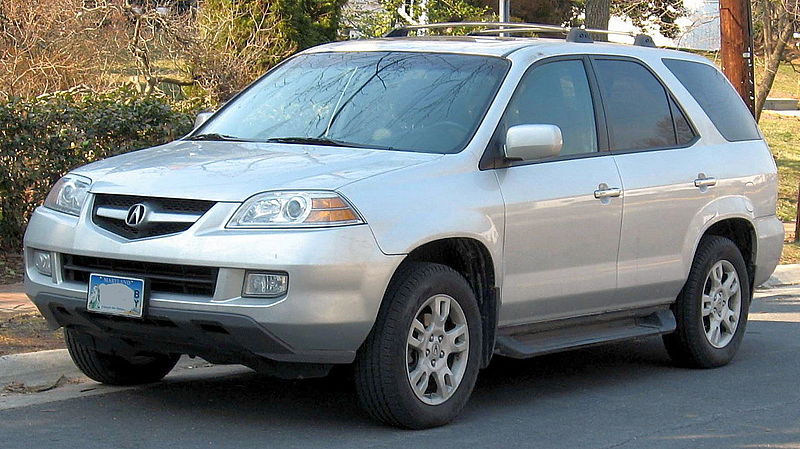 |
| First generation Acura MDX |
Another refreshed Acura introduced in the early 2000s was the MDX, a popular three-row crossover SUV based on the Honda Odyssey minivan. The MDX replaced the slow-selling SLX, which was little more than a rebadged Isuzu Trooper. The MDX was a car-like crossover SUV with limited off-road capability that catered to the demands of the luxury SUV market. It was given top honors by Car and Driver in its first comparison test against seven other SUVs. Other cars in Acura's line-up during this time included the 3.2 TL, 3.2 CL, RSX (formerly the Integra hatchback), and the NSX. By the late 2000s, Acura had dropped the inclusion of engine displacement numbers in its vehicle designations, retaining a simpler, two- or three-letter designation instead (e.g. 3.5 RL became RL). The 1999-2003 TL have been plagued by transmission and other problems.
In 2001, a new coupe, badged as the RSX was introduced to the Acura line up. It was a replacement for the outgoing Integra. The RSX is a rebadged Honda Integra (DC5) from the Japanese market. As a result, the RSX is technically a new generation of the outgoing Integra. Much like the Integra, the RSX was a hit in the tuner market. However, at the end of 2006, the RSX was taken out of the Acura line up, subsequently in the Japanese market as well. It is not known why the RSX did not continue to be sold as the Integra in Japan, however, the reason that Acura gave for the cancellation of the RSX is that Acura wishes to move up in the luxury brand, thus cannot sell a car that is mostly driven by teenagers.
In 2001, a new coupe, badged as the RSX was introduced to the Acura line up. It was a replacement for the outgoing Integra. The RSX is a rebadged Honda Integra (DC5) from the Japanese market. As a result, the RSX is technically a new generation of the outgoing Integra. Much like the Integra, the RSX was a hit in the tuner market. However, at the end of 2006, the RSX was taken out of the Acura line up, subsequently in the Japanese market as well. It is not known why the RSX did not continue to be sold as the Integra in Japan, however, the reason that Acura gave for the cancellation of the RSX is that Acura wishes to move up in the luxury brand, thus cannot sell a car that is mostly driven by teenagers.
2004-2006: RL, TSX, RDX
A new TL debuted for the 2004 model year, with a sharp style, Italian and a 270 hp (200 kW) V6 measured by the then current standards SAE. The new TL increased sales dramatically to 70,943 American units in 2005, surpassing competitors such as the C-Class, G35, CTS, ES 300, and A4. |
| Third generation Acura TL |
Also around the same time the Acura TSX was introduced as a cheaper alternative to the BMW 3-Series. It was essentially a re-badged European and Japanese market Honda Accord loaded with features. This model became the only 4-cylinder sedan in Acura's line-up (with the exception of the Canadian market Acura CSX, which replaced the EL in 2006).
In 2005, a new RL was introduced with a 300 hp (220 kW) V6, improved styling, and Super Handling All-Wheel Drive (SH-AWD), a system capable of sending almost all of the RL's power to just one wheel in a turn. The second-generation RL appeared on Car and Driver's Ten Best list for 2005, and also garnered an CNET.com "Editor's Choice" Award for Top Tech Car. While critically acclaimed, sales have not met expectations, as the price of the RL is perceived to be out of its bracket. As the new RL offered more features and performance than the base version of its luxury competition's (i.e., the base six-cylinder. BMW 5 Series), Honda Japan suggested that it could charge more, though Honda Canada disagreed. The RL's initial MSRP was $69,500 CAD, more than the six-cylinder BMW 525i and close to that of the V8-powered BMW 545i. At the RL's price point, most consumers expected a V8, furthermore they did not perceive Acura as being on par with its German rivals and expected more value from the Japanese marque. The damage from Honda Japan's alleged hubris was done, even though Honda Canada has since reduced the RL's price.
Acura's new models—particularly the TL and TSX—were well received by the motoring press and became Acura's top selling vehicles. The TSX was on Car and Driver's Ten Best list from 2004–2006.
In 2005, a new RL was introduced with a 300 hp (220 kW) V6, improved styling, and Super Handling All-Wheel Drive (SH-AWD), a system capable of sending almost all of the RL's power to just one wheel in a turn. The second-generation RL appeared on Car and Driver's Ten Best list for 2005, and also garnered an CNET.com "Editor's Choice" Award for Top Tech Car. While critically acclaimed, sales have not met expectations, as the price of the RL is perceived to be out of its bracket. As the new RL offered more features and performance than the base version of its luxury competition's (i.e., the base six-cylinder. BMW 5 Series), Honda Japan suggested that it could charge more, though Honda Canada disagreed. The RL's initial MSRP was $69,500 CAD, more than the six-cylinder BMW 525i and close to that of the V8-powered BMW 545i. At the RL's price point, most consumers expected a V8, furthermore they did not perceive Acura as being on par with its German rivals and expected more value from the Japanese marque. The damage from Honda Japan's alleged hubris was done, even though Honda Canada has since reduced the RL's price.
Acura's new models—particularly the TL and TSX—were well received by the motoring press and became Acura's top selling vehicles. The TSX was on Car and Driver's Ten Best list from 2004–2006.
 |
| First generation Acura RDX |
2007-present: ZDX, ILX
 |
| 2010 Acura ZDX |
Acura re-introduced the TL Type-S for the 2007 model year. 2009 marked the all new TL and TSX models as well as a mid-year model update for the RL; all three made their debuts in the 2008 calendar year. Acura planned on redesigning the RL by 2011 as well as announced the creation of a brand new luxury crossover vehicle called the ZDX, previewed by the concept of the same name.
The ZDX was the first Acura designed in Acura's design studio located at Torrance in Southern California. The ZDX was designed by Michelle Christensen and based on the Acura MDX using that vehicles 3.7 litre V6 engine (300 bhp) and SH-AWD system. A common misconception is that it is based on the Honda Crosstour which was based on the Honda Accord rather than the bigger and more complex underpinnings of the MDX. It is also the first Acura to be completely built in North America. The production model of the ZDX made its debut in the Orange County Auto Show in Southern California on October 15, 2009. The concept behind the ZDX is that it is a "four door coupe," and the design emphasis of the body of the car is like a "pulled back slingshot." Another prominent design aspect of the ZDX is the wide rear shoulders above the rear wheels. The ZDX went on sale in December 2009.
The ZDX was the first Acura designed in Acura's design studio located at Torrance in Southern California. The ZDX was designed by Michelle Christensen and based on the Acura MDX using that vehicles 3.7 litre V6 engine (300 bhp) and SH-AWD system. A common misconception is that it is based on the Honda Crosstour which was based on the Honda Accord rather than the bigger and more complex underpinnings of the MDX. It is also the first Acura to be completely built in North America. The production model of the ZDX made its debut in the Orange County Auto Show in Southern California on October 15, 2009. The concept behind the ZDX is that it is a "four door coupe," and the design emphasis of the body of the car is like a "pulled back slingshot." Another prominent design aspect of the ZDX is the wide rear shoulders above the rear wheels. The ZDX went on sale in December 2009.
 |
| 2012 Acura TL |
Acura initially had plans for the third generation of RL to be a rear wheel drive V8 sedan for its flagship, but shelved the plans in the wake of the 2008 economic downturn.
Acura announced new TSX wagon in the 2010 New York Auto Show and the car is due to go on sale in Fall of 2010. The wagon version of the TSX is based on the wagon version of the Euro-spec Honda Accord which has been in the European market for some time. However, Acura did not announce any plans for the third-generation RL.
For the 2010 model year the MDX models received some slight exterior changes and increased equipment levels. Mechanically the engine remained unchanged but the transmission was updated from the previous 5-speeds to 6-speeds including steering column mounted shift override paddles. This new transmission was shared with the ZDX.
In 2012, Acura introduced a new model called the ILX which is based heavily on the Honda Civic platform. It shares the same 3 power train variants from the Civic: the 2.0L, 2.4L VTEC and a 1.5L Hybrid. It also unveiled the Acura RLX Concept, a replacement for the RL sedan, at the New York International Auto Show. The ILX went on sale in May 2012 in the United States as a 2013 model.
Also in 2012, Acura "reinvented" another model, the RDX concept. The RDX concept was is based on the Honda CR-V. For the new model, Acura dropped the 4 cylinder turbo for a 3.5L V6. When the official 2013 Acura RDX was released, it was relatively similar to the concept but had changes in wheels, taillights, and some other cosmetics. A lot of this Acura looks like it's brother the ILX. The 2013 RDX doesn't have the SH-AWD system instead it takes the Intelligent Drive AWD from the CR-V. The RDX is now available with BASE, BASE AWD, TECH., and TECH AWD.
In 2013, Acura showed a 2014 Concept of the MDX. Shortly after, it was released to the public. MDX competes with Lexus RX, Audi A7 and many others. For the first time, buyers of the 2014 MDX didn't have to get the SH-AWD. This model also gets the Jewel Eye LED lights similar to the RLX. The trim levels are BASE, TECH, TECH AND ENTERTAINMENT, and ADVANCE AND ENTERTAINMENT. All of these can be applied with SH-AWD.
For the 2014 model of the RDX. Acura drops color Amber Brownstone which was really popular for Kona Coffee Metallic from the CR-V. The new color is a little darker. No changes for the 2014 ILX. Consumers complained about the lack of accessories(back up sensors, illumination door sill trim, etc.) for the RDX but Acura hasn't changed anything.
Acura announced new TSX wagon in the 2010 New York Auto Show and the car is due to go on sale in Fall of 2010. The wagon version of the TSX is based on the wagon version of the Euro-spec Honda Accord which has been in the European market for some time. However, Acura did not announce any plans for the third-generation RL.
For the 2010 model year the MDX models received some slight exterior changes and increased equipment levels. Mechanically the engine remained unchanged but the transmission was updated from the previous 5-speeds to 6-speeds including steering column mounted shift override paddles. This new transmission was shared with the ZDX.
In 2012, Acura introduced a new model called the ILX which is based heavily on the Honda Civic platform. It shares the same 3 power train variants from the Civic: the 2.0L, 2.4L VTEC and a 1.5L Hybrid. It also unveiled the Acura RLX Concept, a replacement for the RL sedan, at the New York International Auto Show. The ILX went on sale in May 2012 in the United States as a 2013 model.
Also in 2012, Acura "reinvented" another model, the RDX concept. The RDX concept was is based on the Honda CR-V. For the new model, Acura dropped the 4 cylinder turbo for a 3.5L V6. When the official 2013 Acura RDX was released, it was relatively similar to the concept but had changes in wheels, taillights, and some other cosmetics. A lot of this Acura looks like it's brother the ILX. The 2013 RDX doesn't have the SH-AWD system instead it takes the Intelligent Drive AWD from the CR-V. The RDX is now available with BASE, BASE AWD, TECH., and TECH AWD.
In 2013, Acura showed a 2014 Concept of the MDX. Shortly after, it was released to the public. MDX competes with Lexus RX, Audi A7 and many others. For the first time, buyers of the 2014 MDX didn't have to get the SH-AWD. This model also gets the Jewel Eye LED lights similar to the RLX. The trim levels are BASE, TECH, TECH AND ENTERTAINMENT, and ADVANCE AND ENTERTAINMENT. All of these can be applied with SH-AWD.
For the 2014 model of the RDX. Acura drops color Amber Brownstone which was really popular for Kona Coffee Metallic from the CR-V. The new color is a little darker. No changes for the 2014 ILX. Consumers complained about the lack of accessories(back up sensors, illumination door sill trim, etc.) for the RDX but Acura hasn't changed anything.
|
|


List of Acura car models
Category
|
Models
|
Current models
|
ILX, MDX, RDX, RLX, TL, TSX, ZDX
|
Historic models
|
CL, CSX, EL, Integra,
Legend, NSX, RSX, SLX, Vigor, RL
|
Concept cars
|
NSX Concept
|
Racing cars
|
ARX-01, ARX-02a
|
Racing
Almost since its inception, Acura has been involved in American motorsports, specifically in Sports Car Club of America (SCCA) and IMSA GT Championshipseries. Starting in 1991, Acura reached an agreement with Comptech Racing to use the V6 motor of the all-new Acura NSX in Comptech's Camel Lights Spiceprototype. Acura would go on to take the Lights championship in its initial year, including a class win at the 24 Hours of Daytona. Acura and Comptech would take the Lights championships again in 1992 and 1993, as well as another Daytona class win in 1992 and a class win at the 12 Hours of Sebring for 1993. |
| Comptech's 1992 Spice-Acura IMSA GT Championship competitor |
However a change in the IMSA rules would lead to the demise of the Camel Lights, and so Acura moved to touring car racing, joining Realtime Racing in the SCCAWorld Challenge with the NSX in 1996, winning the final two races of the season. In 1997, Acura added Acura Integras to the lower classes, and were successful in taking the championship in both of these classes. Realtime took the touring championship with the Integra again in 1998, and came within a few points of winning it again in 1999 only to lose it in the final race, then coming back to retake the title in 2000.
Although Realtime had abandoned the NSX program in 1998, the NSXs returned to the top class in 2001. Although the NSX squad suffered mechanical woes and were unable to take the title, the Integras of the touring class once again took the teams championship. By 2002, Acura replaced the aged Integra with the newAcura RSX in the final races of the season, scoring good finishes in their debut. At the same time, Acura finally retired the NSXs from the top GT class. The RSXs would later be joined by new Acura TSXs in 2004. Realtime continues to campaign the RSX and TSX in the SCCA Speed World Challenge. Acura also currently races RSXs and TSXs in the Grand American Road Racing Association's KONI Challenge Series for touring cars.
Although Realtime had abandoned the NSX program in 1998, the NSXs returned to the top class in 2001. Although the NSX squad suffered mechanical woes and were unable to take the title, the Integras of the touring class once again took the teams championship. By 2002, Acura replaced the aged Integra with the newAcura RSX in the final races of the season, scoring good finishes in their debut. At the same time, Acura finally retired the NSXs from the top GT class. The RSXs would later be joined by new Acura TSXs in 2004. Realtime continues to campaign the RSX and TSX in the SCCA Speed World Challenge. Acura also currently races RSXs and TSXs in the Grand American Road Racing Association's KONI Challenge Series for touring cars.
 |
| Highcroft Racing's ARX-01a |
At the Detroit Auto Show in 2006, Acura announced their plans to enter the American Le Mans Series with multiple teams of Le Mans prototypes in the LMP2 class starting in 2007 season. The cars would be purchased chassis from existing manufacturers, but use American-built Acura V8s (a first for Acura and Honda). Acura also announced their initiative to take the cars to the 24 Hours of Le Mans in 2008 and eventually move to the superior LMP1 class with cars built by Acura themselves in 2009. Later in 2006, Acura announced that the three factory teams would be Andretti Green Racing,Fernández Racing, and Highcroft Racing, and that the chassis would be built by Lola Cars of the UK and Courage Compétition of France.
The three Acura-powered prototypes debuted at the 2007 12 Hours of Sebring, which was the opening round of the ALMS season, and were successful in their debut. Andretti Green's Acura took second place overall and first in the LMP2 class, while Fernández Racing took third overall, and Highcroft sixth, beating a series of established Porsche teams in their class. At the same time, Acura began development of their own chassis by heavily modifying their purchased Courage chassis. The cars now have been so radically changed from their original orientation that they are now named Acura ARX-01a. Acura will introduce evolved B-spec cars in the 2008 season, with Gil de Ferran launching a fourth Acura team in the ALMS.
The three Acura-powered prototypes debuted at the 2007 12 Hours of Sebring, which was the opening round of the ALMS season, and were successful in their debut. Andretti Green's Acura took second place overall and first in the LMP2 class, while Fernández Racing took third overall, and Highcroft sixth, beating a series of established Porsche teams in their class. At the same time, Acura began development of their own chassis by heavily modifying their purchased Courage chassis. The cars now have been so radically changed from their original orientation that they are now named Acura ARX-01a. Acura will introduce evolved B-spec cars in the 2008 season, with Gil de Ferran launching a fourth Acura team in the ALMS.
Marketing
Acura's current marketing slogan is "Advance." Recent models include Technology, Advance, Type-S, and SH-AWD trim levels. Technology and Advance models typically come with the latest hi-tech features such as keyless start and a blind spot information system. Type-S and SH-AWD models are performance-oriented, with a substantial increase in horsepower compared to the lower trim levels. Some models, such as the TL, also combine trim levels (i.e. "SH-AWD with Advance"). |
| 2012 Acura NSX Concept |
Acura began an association with Marvel Entertainment in 2010, upon release of the film Iron Man 2, which featured a ZDX after the ending credits. On April 20, 2011, Acura and Marvel announced a promotional campaign, making Acura the official brand of Marvel's fictional S.H.I.E.L.D. organization. Soon thereafter, several Acura models—such as the MDX, ZDX, RL, and TL—appeared in the films Thor and Captain America: The First Avenger. In the 2012 film, The Avengers, Iron Man (played by Robert Downey, Jr.) drove an exotic sportscar by Acura, made specifically for the film, rather than theAudi R8 he previously drove. It was rumored that the car spotted during filming was a concept for the second generation NSX, however, a different-looking 2012 Acura NSX Concept was unveiled at the North American International Auto Show, on January 9, 2012.
From 1995 to 2007, Acura sponsored two WTA Tour tennis tournaments, both named the Acura Classic.
In 2012, Acura was the presenting sponsor and official vehicle of the Sundance Film Festival.
Acura also has a 'Mobility Program' that ensures drivers who are disabled are safe in their vehicles. The program offers cash reimbursement towards the cost of adaptive equipment for disabled drivers.
From 1995 to 2007, Acura sponsored two WTA Tour tennis tournaments, both named the Acura Classic.
In 2012, Acura was the presenting sponsor and official vehicle of the Sundance Film Festival.
Acura also has a 'Mobility Program' that ensures drivers who are disabled are safe in their vehicles. The program offers cash reimbursement towards the cost of adaptive equipment for disabled drivers.
Timeline
1986
Acura debuts in North America as the first Japanese luxury marque.
1990
Acura dealerships in the US win their fifth consecutive first-place ranking on the Customer Satisfaction Index by J. D. Power and Associates Acura announces that it will expand research and development in the US The second generation Integra is introduced
 |
| 1992–1994 Acura Vigor |
 |
| Third generation Acura Integra |
 |
| The 2009 Acura TSX |
- 2006
- Acura is introduced in China
- Acura RDX is introduced with SH-AWD
- Acura introduces CSX to replace EL, and is only sold in Canada
- The RSX (as well as the Honda Integra) is discontinued
- The TSX gets mid-model change with 5 more horsepower
- 2007
- Acura MDX receives a redesign
- Acura TL Type-S is reintroduced, and the CSX Type-S is introduced in Canada
- 2008
- Acura introduces the new RL, which receives a mid-model change redesign
- Acura introduces new TSX at the New York Auto Show
- 2009 model year
- Acura TSX receives a redesign
- Acura TL receives a redesign
- Acura RL receives a mid-model change
- Acura CSX receives a mid-model change
- 2010 model year
- Acura introduces all new ZDX
- Acura MDX receives a mid-model change
- Acura RDX receives a mid-model change
- Acura TSX receives an optional V6 engine from the TL and a minor mid-model change
- 2011 model year
- Acura TSX Sport Wagon is introduced
- Acura CSX is dropped
- 2012 model year
- Acura TL gets mid-model change
- Acura TSX Special Edition is introduced
- 2013 model year
- Acura ILX is introduced
- Acura RDX receives a redesign
- 2014 model year
- Acura RLX is released to the market.
Acura RDX gets little changes.
Acura MDX is released to the market.
Last updated on 28 August 2013 at 22:58.
Read More »


.JPG "Isuzu Motors' head office (Minami- ōi, Shinagawa Ward, Tokyo)")
.jpg "1966 Isuzu Bellett 1600 GT (PR90)")


+registration+plates.jpg "Isuzu Gemini with European (Maltese) registration plates")
+light+truck.jpg "Isuzu NHR (Elf) light truck")

+heavy+truck.jpg "Isuzu CXZ (Giga) heavy truck")
.jpg "Isuzu Journey operated by Citibus (New Zealand)")


